The Mediterranean basin represents one of the most complex geopolitical and naval chessboards in the world. Beneath the blue surface, a silent fleet of conventional and nuclear-powered submarines moves constantly. To ensure maritime trade route security and strategic deterrence, NATO and allied aerospace forces conduct relentless maritime patrol and antisubmarine warfare (ASW) missions. Thanks to ground receivers and the global network of map.adsbitalia.it, aviation enthusiasts and radar tracking specialists can regularly follow the tactical flight profiles of key assets such as the US Navy Boeing P-8A Poseidon and the Italian Air Force Leonardo P-72A.
â¡ Technical Sheet & Operational Data
Architecture of ASW Missions in the Mediterranean
Maritime patrol missions are not mere transit flights, but complex tactical operations conducted in coordination with surface naval units and operational command centers. The deployed aircraft often operate at intermediate flight levels (FL180 - FL240) during transit to operating areas, before descending to lower altitudes or establishing loitering patterns in specific zones such as the Strait of Sicily or the eastern Ionian Sea.
The core of these operations lies in the ability to deploy and monitor sonobuoy fields capable of detecting the acoustic signatures of underwater targets. Signals are processed onboard by advanced acoustic suites, while surface search radars (such as the AN/APY-10 on the Poseidon and the EL/M-2022A(V)3 on the P-72A) scan the horizon for anomalous radar returns or periscope signatures.
Comparing the Boeing P-8A Poseidon and Leonardo P-72A

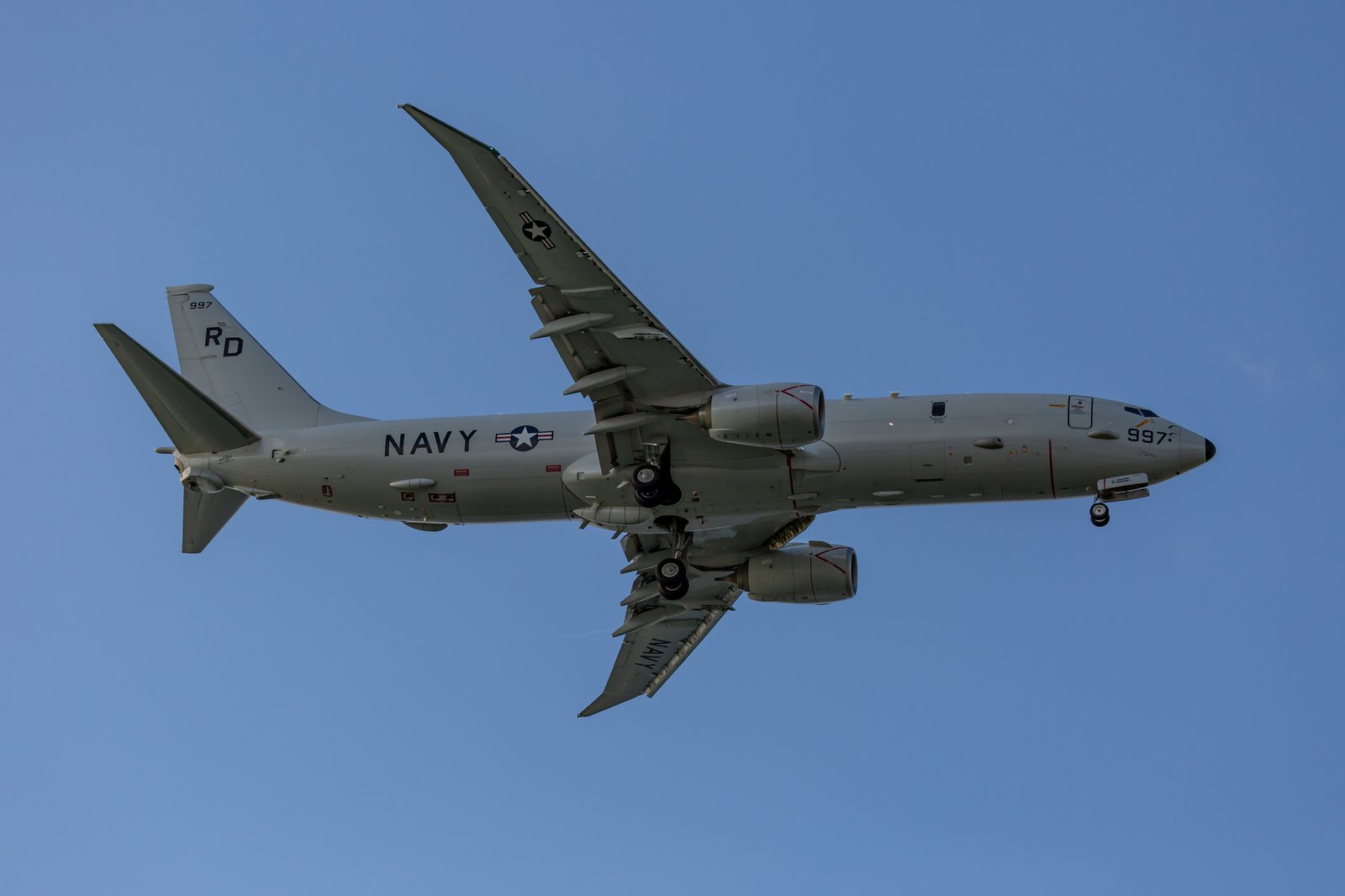
The backbone of NATO's heavy patrol force is the Boeing P-8A Poseidon, derived directly from the robust Boeing 737-800 airframe with modified 737-900 wings. Powered by twin CFM International CFM56-7B turbofans, the Poseidon combines intercontinental range with a state-of-the-art sensor suite. Meanwhile, the Italian Air Force successfully operates the Leonardo P-72A (military variant of the ATR 72-600), optimized for coastal surveillance, search and rescue (SAR), and medium-range antisubmarine warfare.
| Characteristic | Boeing P-8A Poseidon | Leonardo P-72A |
|---|---|---|
| Powerplant | 2x CFM56-7B (27,300 lbf each) | 2x Pratt & Whitney Canada PW127M |
| Operational Endurance | Up to 1,200 nm with 4h on station | Up to 10 hours mission endurance |
| Primary Sensors | AN/APY-10 Radar, EO/IR Turret, ESM | EL/M-2022 Radar, FLIR StarSafire HD |
| Tactical Payload | MK 54 Torpedoes, Harpoon, Sonobuoys | Lightweight Torpedoes, Mines, SAR Kit |
ADS-B Tracking and Mode-S Telemetry in the Mediterranean
For enthusiasts and researchers utilizing 1090 MHz SDR receivers, tracking these military assets provides a unique window into European air defense operations. Many of these flights keep their Mode-S transponders active with assigned operational squawk codes, although during delicate tactical phases position data may be partially masked or managed through encrypted mission callsigns.
* * * * * * * * * * * * * * * * * * * * * * * * * * * * * * * * * *
ICAO Hex: AE67A2 | Callsign: RCH442 / PAT82
Aircraft: Boeing P-8A Poseidon (USN VP-46)
Message Type: 17 (Extended Squitter Airborne Position)
Latitude: 37.4821 | Longitude: 15.1294
Altitude: FL210 | Ground Speed: 342 kts | Track: 142 deg
Squawk: 4721 | Emergency: None
Timestamp: 2026-06-06 14:22:10 UTC
* * * * * * * * * * * * * * * * * * * * * * * * * * * * * * * * * *