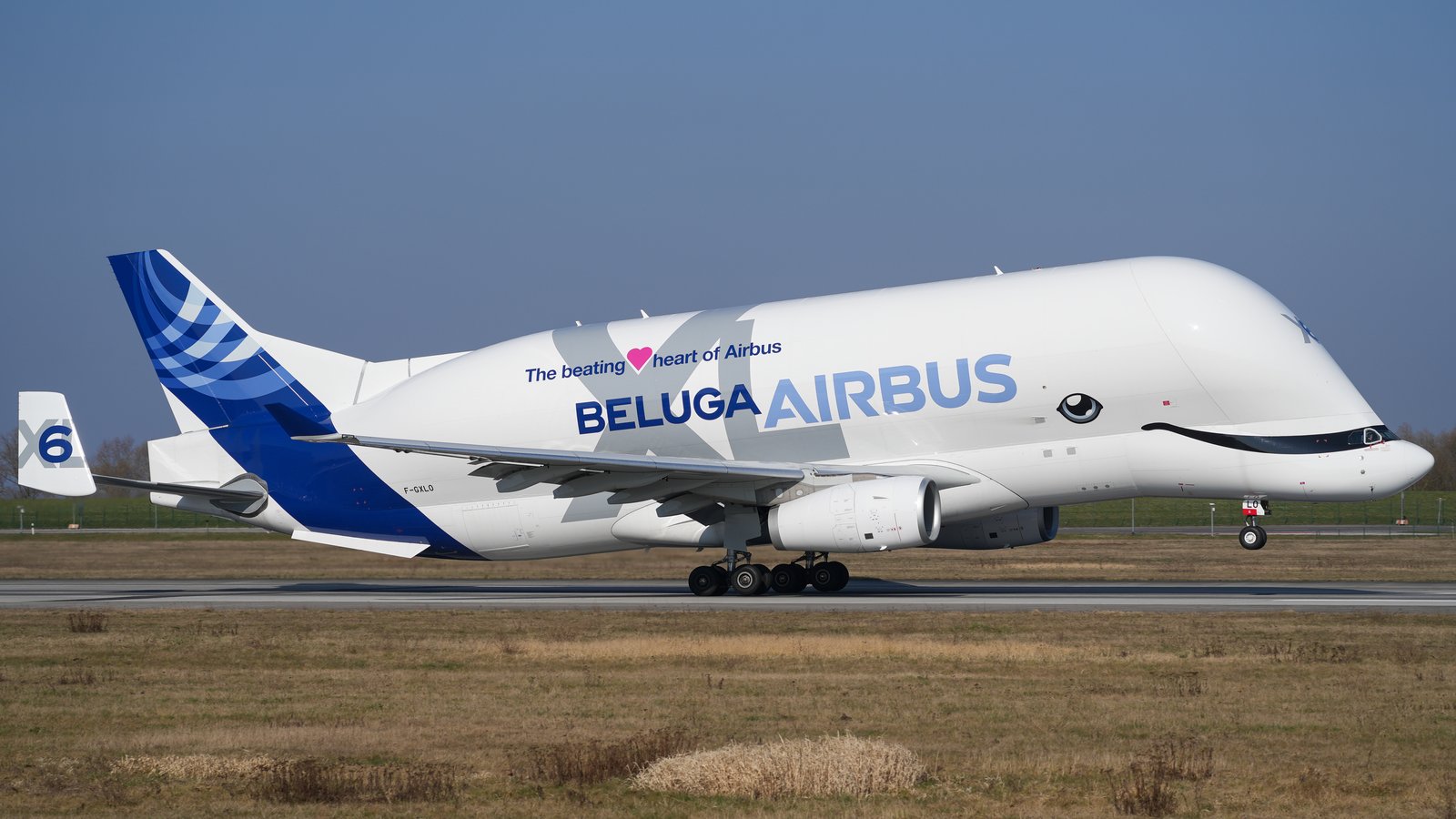
In the realm of aerospace industrial logistics, the Airbus BelugaXL (official technical designation A330-743L) stands as one of the most imposing and unmistakable engineering marvels cruising European skies. Derived from the robust A330-200 long-haul twinjet, this aerial behemoth was specifically designed to transport complete wings, fuselages, and structural components between Airbus production sites across Europe—connecting key facilities like Toulouse (TLS), Hamburg (XFW), Broughton (CEG), and Saint-Nazaire (SNR). Tracking this giant via 1090 MHz receivers and our Live Radar Map map.adsbitalia.it offers radar enthusiasts a fascinating telemetry experience.
⚡ Quick Facts & Operational Data
Aerodynamic Engineering and Structural Modifications over the A330
Transforming an A330-200 into a BelugaXL required radical structural modifications led by Airbus engineering teams. The most striking change lies in the forward and upper fuselage section, where a massive bulbous structure was grafted, giving the aircraft its iconic whale-like profile adorned with a friendly smile in a special livery. To maintain directional and pitch control with such a colossal payload volume and oversized frontal area, engineers lowered the cockpit and significantly enlarged the vertical stabilizer, while also adding ventral stabilizing surfaces at the rear of the fuselage.
The internal cargo hold boasts a staggering useful volume of 2,200 cubic meters, capable of simultaneously accommodating two complete sets of Airbus A350 wings. During cruise phases, typically performed between Flight Levels 200 and 280, the aircraft manages complex airflow dynamics around the upper fairing, requiring precise calibration of trim tabs and fly-by-wire flight control software.
Propulsion and Operational Performance
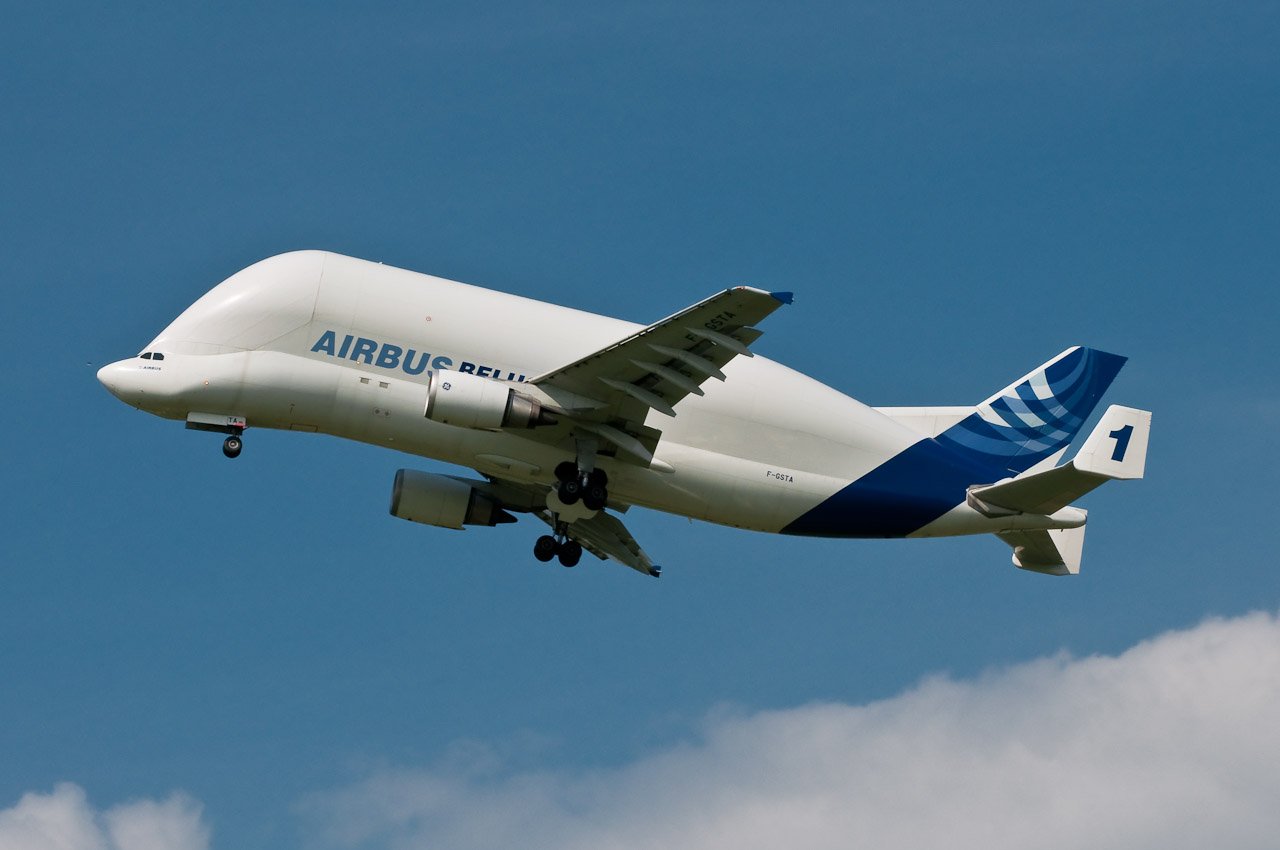
Powering this colossal cargo aircraft are two robust Rolls-Royce Trent 700 turbofan engines, each capable of delivering a nominal thrust in the 72,000 lbf range (approx. 320 kN). Given the aerodynamic drag induced by the mammoth upper fuselage, the BelugaXL's mission profile favors slightly lower cruise speeds than the standard passenger variant, typically hovering around Mach 0.70 - 0.72. Despite the enormous frontal cross-section, full-load range reaches 4,000 kilometers, easily covering all strategic routes within Airbus's European supply chain.
| Technical Parameter | Airbus A330-743L BelugaXL | Airbus A330-200 (Base) |
|---|---|---|
| Wingspan | 60.3 meters | 60.3 meters |
| Overall Length | 63.1 meters | 58.8 meters |
| Maximum Height | 18.9 meters | 16.8 meters |
| Max Takeoff Weight (MTOW) | 227 tonnes | 242 tonnes |
| Internal Cargo Volume | 2,200 m³ | N/A (Standard Passenger/Cargo) |
* Message Type: 17 (Extended Squitter)
* ICAO 24-bit Hex: 380F7C (F-GXLN - Airbus Transport International)
* Call-sign: BGA13XL
* Airborne Position Message:
  - Latitude: 43.6291° N
  - Longitude: 1.3638° E (Near Toulouse-Blagnac LFBO)
  - Barometric Altitude: FL220 (22,000 ft)
  - Ground Speed: 385 kts, Track: 142°
  - Vertical Rate: +1,250 ft/min (Climb out)
* ADS-B Squawk: 4721
Radar Tracking and European Routes on ADSBItalia Network
For air traffic monitoring enthusiasts utilizing 1090 MHz SDR receivers with dump1090 or readsb, intercepting BelugaXL flights is a thrilling experience. Operated by subsidiary airline Airbus Transport International (ATI), flights frequently use the BGA series call-sign (e.g., BGA11XL, BGA24XL). Heavily traveled routes include links between Toulouse (LFBO) and Hamburg-Finkenwerder (EDHI), alongside periodic flights to Broughton in the UK (EGNR) for wing transport. Thanks to our community's coverage, every takeoff and landing of this unique fleet is recorded with pinpoint precision.
We invite all feeders and enthusiasts to share their radar data and consult our ADSBItalia Feeder Guide to optimize their 1090 MHz receiving stations and track European sky giants in real time.