

When an Antonov An-124 Ruslan lifts off the runway, wildlife and radar tracking enthusiasts alike come to a halt. With a maximum takeoff weight approaching 402 tonnes and a fuselage designed to carry outsized cargo impossible for any other commercial aircraft, the Ukrainian four-engine giant is one of the most majestic tracks to intercept on the screens of the map.adsbitalia.it network.
⚡ Quick Facts & Operational Data
The Aerodynamic Engineering of the Ukrainian Colossus
Originally designed by the Antonov OKB in the 1980s as a strategic military and civil transport, the An-124 Ruslan boasts unique aerodynamic solutions. The moderately swept wing, featuring a supercritical profile, is optimized for efficient cruise speeds at Mach 0.70 - 0.72. The pressurized cargo section is over 36 meters long and 6.4 meters wide, enabling the transport of locomotives, electrical transformers, and spacecraft satellites.
The landing gear system consists of 24 wheels, specifically engineered to distribute weight across unpaved or semi-prepared runways (in its original military guise). The nose-kneeling system allows the aircraft to lower its forward cargo ramp threshold to ease loading operations via onboard integrated cranes.
| Technical Parameter | An-124-100 Specifications |
|---|---|
| Wingspan | 73.30 meters |
| Total Length | 68.96 meters |
| Takeoff Thrust (per engine) | 229.5 kN (51,590 lbf) - Progress D-18T turbofan |
| Max Takeoff Weight (MTOW) | 402,000 kg |
| Max Payload | 120,000 kg (120 tonnes) |
| Typical Cruise Speed | 800 - 850 km/h (FL280 - FL350) |
ADS-B Tracking and 1090 MHz Telemetry
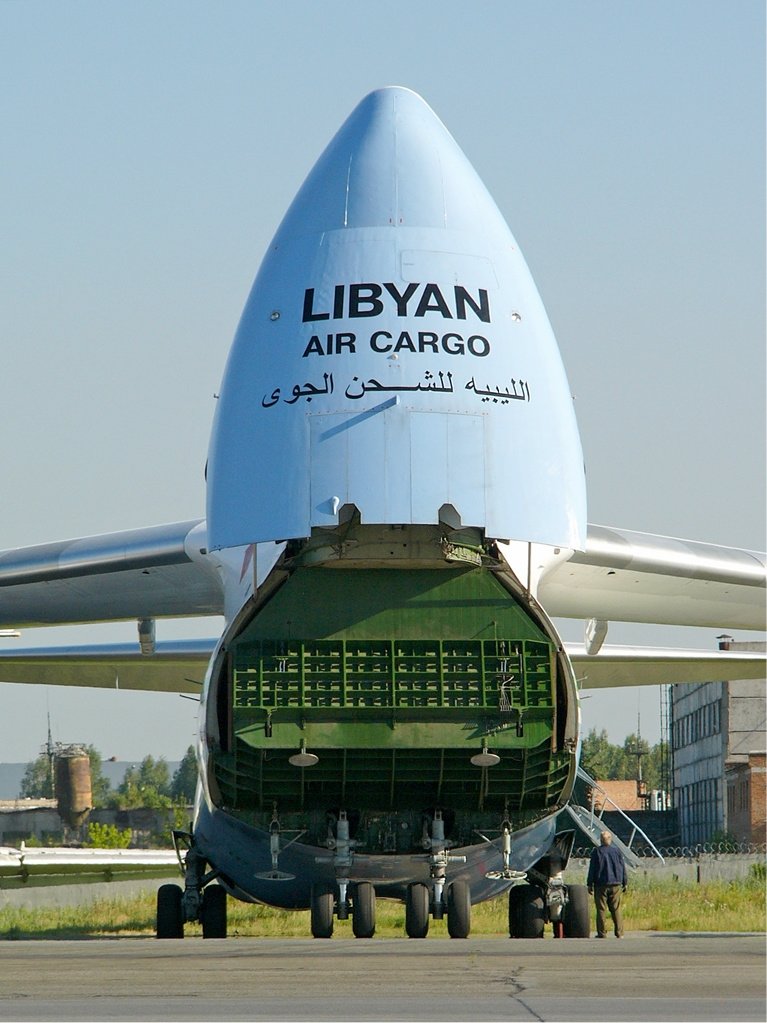
From the perspective of ground-based SDR receivers, tracking an An-124 offers fascinating technical insights. Although modern airliners rely on state-of-the-art GPS-augmented ADS-B transponders, many legacy airframes operate with upgraded Mode-S transponders regularly broadcasting identification messages (ICAO 24-bit hex), barometric altitude, and velocity vectors.
During initial climb phases from hubs like Leipzig/Halle (EDDP) or Anchorage (PANC), the reduced vertical rate caused by the high thermal and mass inertia of the Progress D-18T engines provides an unmistakable radar signature on telemetry charts.
*$ADSB,1M,5083B2,14:32:01.884,FL310,N0450,210,034*
ICAO Hex: 5083B2 (Example UR-82060)
Flight Status: Airborne
Altitude: 31,000 ft (Barometric)
Ground Speed: 450 knots (Mach 0.74)
Track: 210° True
Vertical Rate: +64 ft/min (Cruise leveling)
Global Operations and Strategic Routes
An-124 routes constantly touch major global logistics hubs. Despite geopolitical challenges and limited spare parts availability for the D-18T engines following international sanctions, the active fleet continues to perform humanitarian missions, outsized industrial transport, and aerospace support. Enthusiasts can follow their movements in real-time by checking our Live Radar Map map.adsbitalia.it.