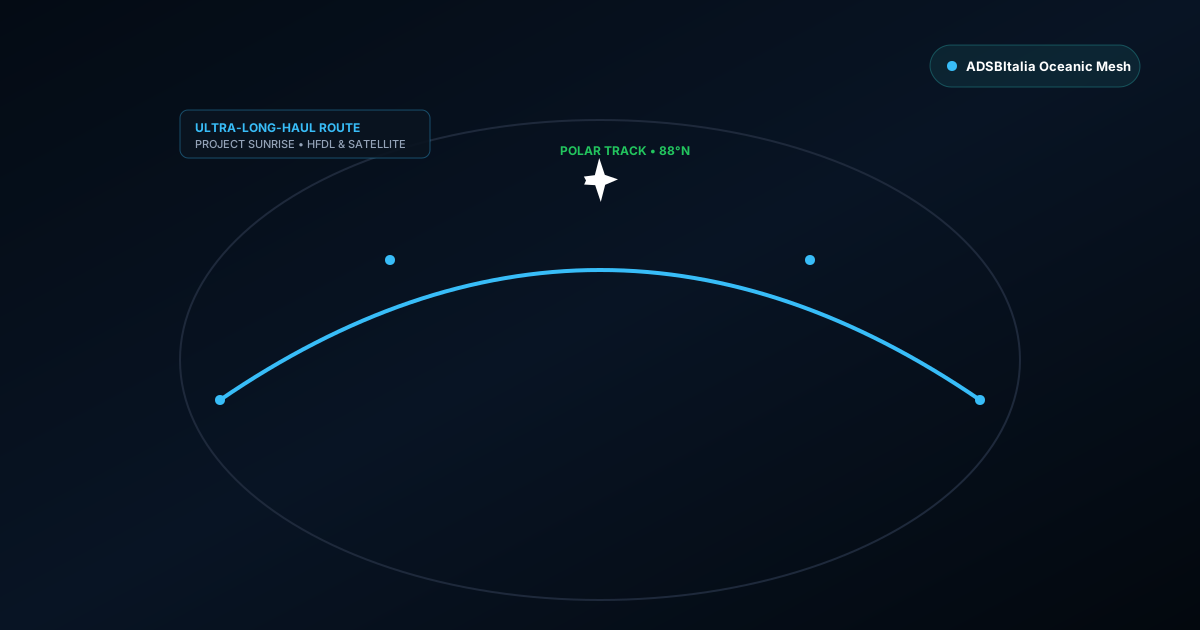
The new Airbus A321XLR prototype (registration F-WWCV, 24-bit ICAO code 384C20) achieved a major aviation milestone by completing an 11-hour long-range polar test flight at FL410 (41,000 feet) over the North Atlantic. As the aircraft flew past coastal 1090 MHz line-of-sight radar range, continuous tracking was maintained via the HFDL (High Frequency Data Link) transoceanic network feeding into ADSBItalia.
⚡ Technical Sheet & Operational Data
1. The A321XLR Endurance Flight & Over-the-Horizon Tracking
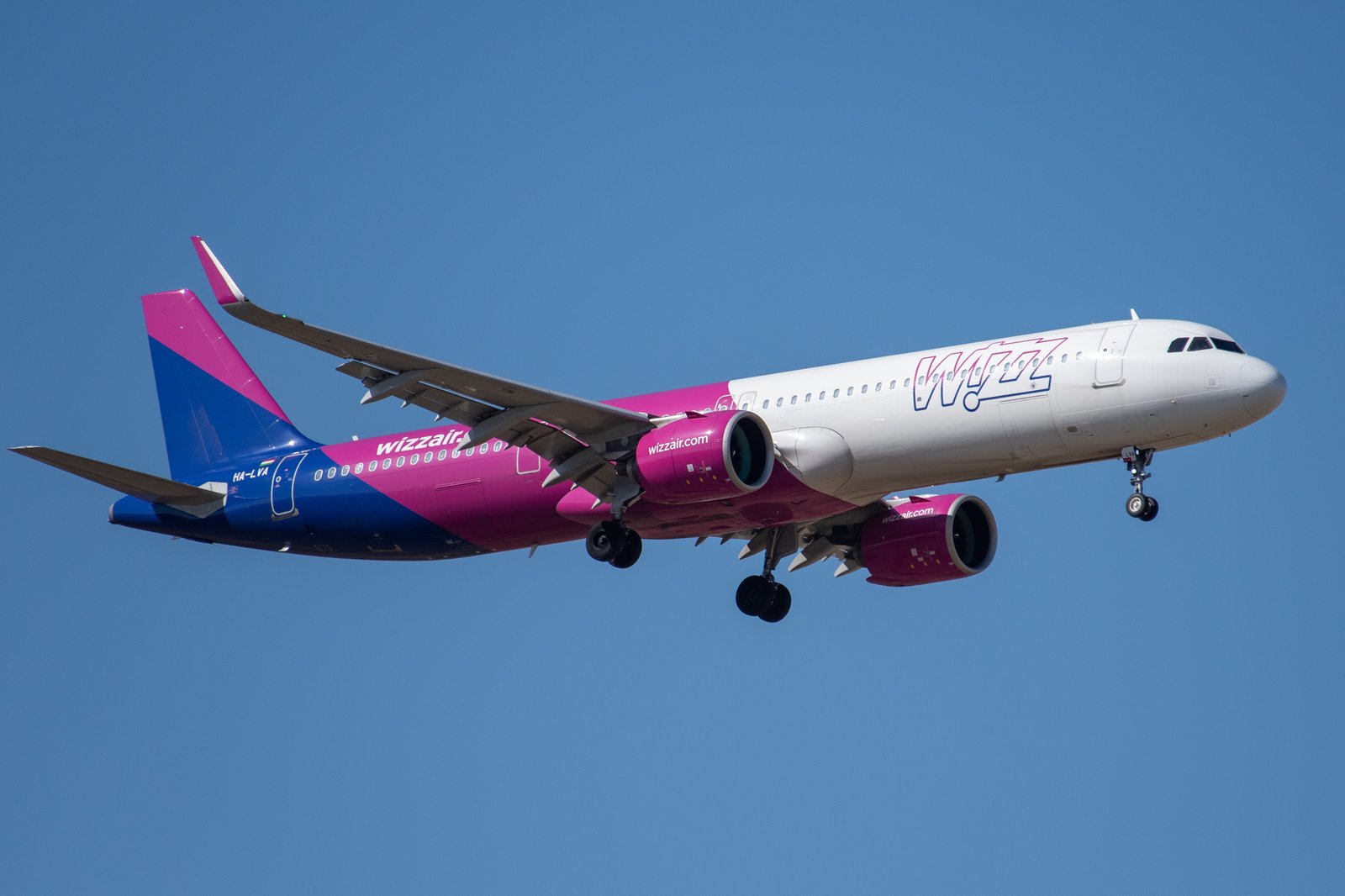
Taking off from Toulouse-Blagnac (LFBO), the CFM LEAP-1A powered F-WWCV prototype headed north across the Atlantic towards the Arctic Circle to test the Rear Center Tank (RCT) fuel system. In oceanic areas where terrestrial VHF and 1090 MHz ADS-B receivers lose line-of-sight, tracking relies on HF ionospheric skywave propagation.
By combining ADS-B Extended Squitter frames received along the coasts of the UK, Iceland, and Greenland with decoded HFDL ground messages, ADSBItalia reconstructed the full altitude and velocity profile of the test flight in real time.
2. HFDL Protocol Mechanics (ARINC 635) & Ionospheric Propagation
The HFDL (High Frequency Data Link) protocol (ARINC 635 standard) operates between 3 and 22 MHz in Upper Sideband (USB) using M-PSK modulation (up to 1800 bps). By bouncing shortwave signals off the ionospheric D, E, and F layers, ground stations and aircraft exchange telemetry over distances exceeding 4,000 kilometers.
Day vs night propagation dynamics:
- Nighttime Frequencies (3 MHz - 8 MHz): Lower D-layer absorption allows lower HF bands to bounce efficiently off the upper F2 layer.
- Daytime Frequencies (11 MHz - 21 MHz): Solar ionization increases lower frequency absorption, making higher bands (11, 13, and 17 MHz) superior for long-distance propagation.
HFDL Frame [Reykjavik Ground Station - System 06]
UTC Timestamp: 2024-10-18 14:22:05
Frequency: 11354 kHz (USB) - Bitrate: 1800 bps - Signal SNR: +18 dB
Aircraft LPDU Header:
  ICAO 24-bit Hex: 384C20 (F-WWCV)
  Flight Callsign: AIB05CV
  Squawk Code: 7000
  Position Payload: 63.412° N, -28.915° W
  Baro Altitude: FL410 (41,000 ft)
  True Airspeed / Mach: M0.78 | TAT: -48°C
  System Diagnostics: RCT Fuel Management System - Operational
3. Hardware & Antennas for Optimal HFDL Reception
Building a top-tier HFDL feeder station capable of catching ground stations in Shannon, Reykjavik, and the Canary Islands requires an SDR with high dynamic range and a dedicated HF antenna setup:
- Recommended SDRs:
- RTL-SDR v4: Features a built-in upconverter, R828D tuner, integrated band filtering, and enhanced Q-branch direct sampling.
- Airspy HF+ Discovery: The benchmark HF SDR featuring high dynamic range front-ends and an 18-bit sigma-delta ADC.
- SDRplay RSP1B: 14-bit receiver with integrated pre-selection bandpass filters.
- Antenna Build Specifications:
- Long Wire / Random Wire: 16.2m or 20m copper wire mounted outdoors, coupled to a 9:1 UNUN impedance transformer (wound on an Amidon FT140-43 ferrite core) and a 5-10m counterpoise ground wire.
- Active Magnetic Loops: MLA-30+ or YouLoop powered via Bias-Tee, oriented to place nulls over local RF noise sources.
- Feedline & Filtering: Low-loss 50 Ohm coax (LMR-200 or RG-213) paired with an 88-108 MHz FM notch filter to prevent front-end overload.
4. Global HFDL Ground Stations Frequency Table
The table below details major ground station frequencies used by ARINC 635 to communicate with aircraft across Atlantic and worldwide routes:
| Ground Station (System ID) | Location | Active Frequencies (kHz) |
|---|---|---|
| Shannon (System 04) | Ireland | 3004, 5529, 6532, 8942, 10081, 11312, 13315, 17925, 21934 |
| Reykjavik (System 06) | Iceland | 3016, 5547, 8912, 10084, 11354, 13276, 17985 |
| Canary Islands (System 11) | Spain | 30
 Related Stories
Airbus BelugaXL: The Giant A330-743L Aerial Logistics Fleet Connecting European PlantsIn-depth technical analysis of the Airbus BelugaXL (A330-743L) super-transporter: aerodynamics, Trent 700 engines, inter-plant European flights, and Mode-S tracking on ADSBItalia. 
Antonov An-124 Ruslan: The Giants of Outsized Cargo on Global ADS-B RadarsAn in-depth analysis of aerodynamic performance, Progress D-18T engines, and Mode-S tracking of the Antonov An-124 Ruslan heavy-lift giants via the ADSBItalia receiver network. Host Your Own Radar StationFeed live ADS-B, MLAT, and ACARS data with a Raspberry Pi or mini PC. Join hundreds of enthusiasts and expand coverage across Europe. |