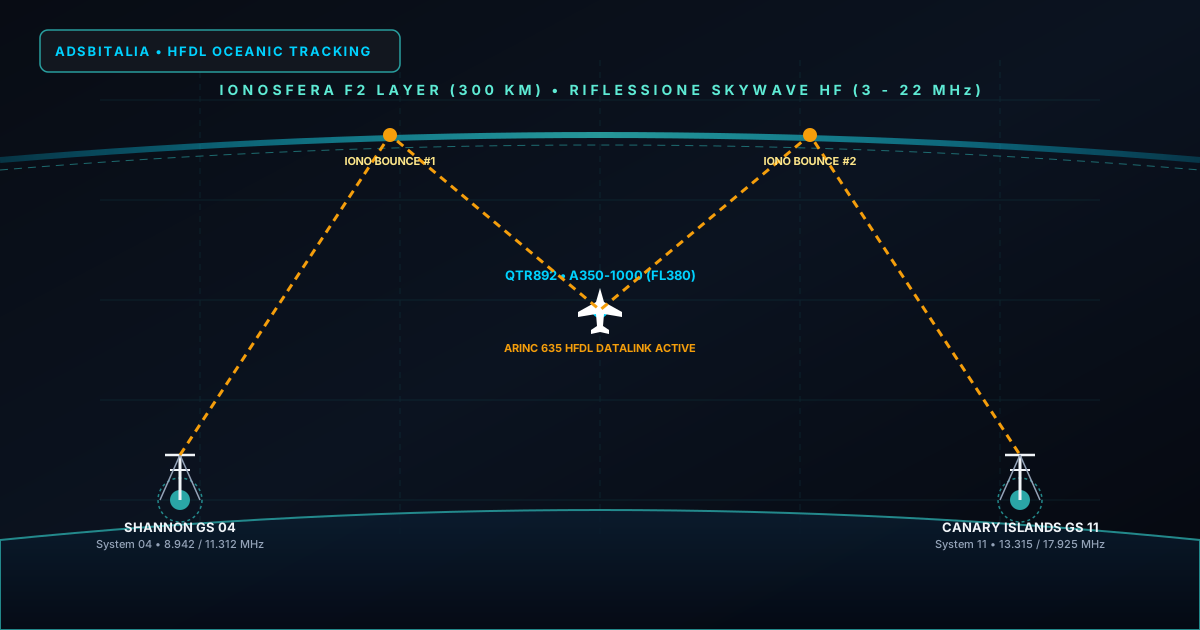
Modern aeronautical tracking is no longer restricted to VHF line-of-sight (1090 MHz ADS-B and 131.525 MHz ACARS). Thanks to SDR technology and shortwave systems, enthusiasts can monitor aircraft flying over oceans and remote regions by intercepting HFDL (High Frequency Data Link) transmissions, operating in the high frequency band (HF between 2 and 30 MHz) via ionospheric propagation.
⚡ Scheda Tecnica & Dati Operativi
1. Hardware and Antennas for the HF Band
Receiving HFDL requires careful design of the receiving system due to the atmospheric and industrial noise typical of shortwaves. Unlike VHF, antenna installation plays a crucial role.
- Dedicated SDRs: The RTL-SDR v4 is the ideal entry-level choice thanks to its built-in direct sampling on the Q-branch for HF frequencies. For superior performance in noisy environments, the Airspy HF+ Discovery or SDRplay RSP1B offer exceptional dynamic range and prevent front-end overload.
- Long Wire / Random Wire Antenna: A copper wire measuring 16.2 meters or 20 meters strung across a garden or roof, coupled via a 9:1 UNUN impedance transformer built with an Amidon FT140-43 ferrite core. A proper RF ground or counterpoise of at least 5-10 meters is essential.
- Active Loop Antennas: Solutions like the MLA-30+ or YouLoop (powered via Bias-Tee) are excellent in urban environments to attenuate local noise by orienting the nulls of the polar pattern toward noise sources (switching power supplies, routers).
- Cables and Filters: Use low-loss 50 Ohm coaxial cable (RG-58 for short runs, LMR-200 or RG-213 for long runs) and always insert a broadcast FM notch filter (88-108 MHz) or an HF low-pass filter to block commercial interference.
2. Operating Frequencies and Ground Stations Table
HFDL ground stations (GS) transmit on frequencies assigned based on ionospheric propagation, which varies radically between day and night. Lower frequencies (3-8 MHz) are preferred at night, while medium and high frequencies (11-21 MHz) are used during the day. Modulation is strictly Upper Sideband (USB).
| Ground Station | ICAO System | Main Frequencies (kHz) |
|---|---|---|
| Shannon (Ireland) | System 04 | 3004, 5529, 6532, 8942, 10081, 11312, 13315, 17925, 21934 |
| San Francisco (USA) | System 01 | 5547, 8957, 10075, 11348, 13315, 17928 |
| Reykjavik (Iceland) | System 06 | 3016, 5547, 8912, 10084, 11354, 13276, 17985 |
| Auckland (New Zealand) | System 03 | 3470, 5547, 8912, 11354, 17919 |
| Canary Islands (Spain) | System 11 | 3004, 5529, 8942, 11312, 13315, 17925 |
3. Installing the 'dumphfdl' Decoder
The standard reference software for Linux and Raspberry Pi is dumphfdl developed by szpajder. Below are the exact commands to build and install the package from source:
sudo apt update && sudo apt install -y build-essential cmake libglib2.0-dev libconfig-dev librtlsdr-dev libsoapysdr-dev
git clone https://github.com/szpajder/dumphfdl.git
cd dumphfdl && mkdir build && cd build && cmake .. && make -j$(nproc) && sudo make install
Once installation is complete, you can start multi-channel monitoring using SoapySDR with the following operational command:
dumphfdl --soapysdr driver=rtlsdr --gain 40 --sample-rate 2400000 8942 10081 11312 13315 --output decoded:text:file:path=-[2023-10-27 14:22:10] Station: Shannon [04] Freq: 8942.0 kHz Aircraft: N1810R (B777) - SQ 7000 - Lat: 52.45 N, Lon: 20.12 W APDU: Ground-to-Air CPDLC Position Report Acknowledgement
4. Share Your Data with ADSBItalia (Feeding HFDL/ACARS)
You can forward the decoded telemetry stream from HFDL and ACARS directly to ADSBItalia aggregator servers via UDP/TCP protocol towards feed.adsbitalia.it. For detailed client configuration and feeder daemons, check our ADSBItalia ACARS/HFDL Feeder Guide and join the community by viewing live data on map.adsbitalia.it.