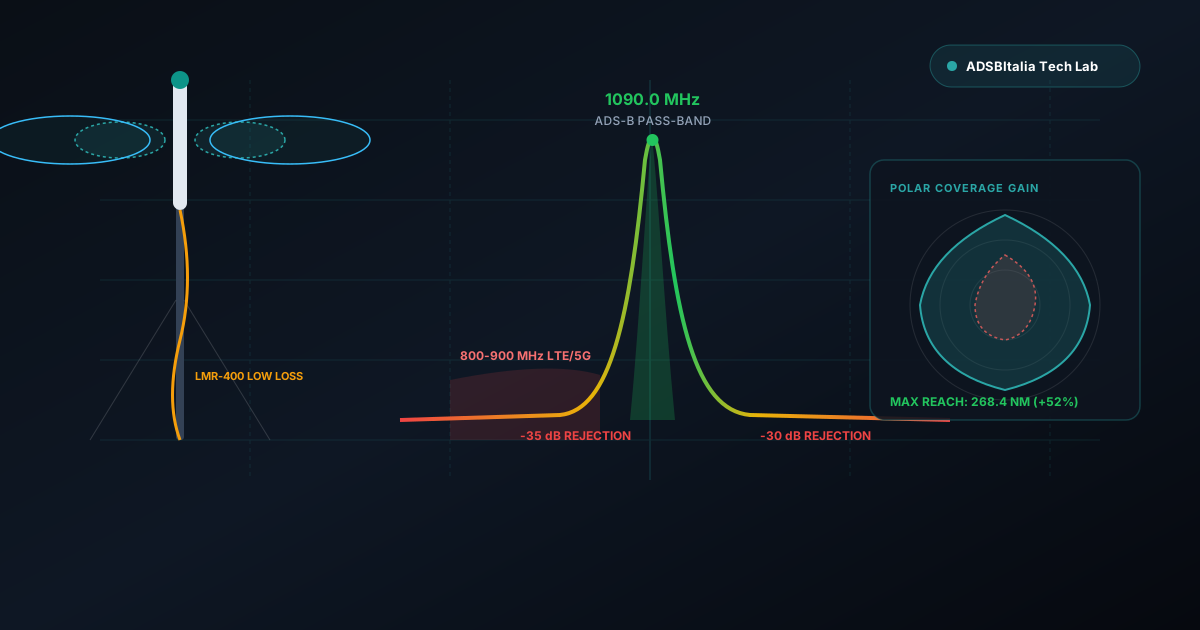
In air traffic monitoring via Mode-S and ADS-B at 1090 MHz, every single decibel of gain (or loss) along the transmission line makes the difference between tracking an en-route aircraft at FL380 over 250 nautical miles or missing critical position packets. Many enthusiasts invest in high-gain collinear antennas or excellent SAW filters, only to waste all gains by using cheap RG-58 coaxial cable runs. In this article, we analyze the results of empirical tests conducted with a Vector Network Analyzer (VNA) on 15-meter runs, comparing legacy RG-58 with efficiency champions LMR-400 and Ecoflex 10.
⚡ Scheda Tecnica & Dati Operativi
1. The Achilles' Heel of the Line: Attenuation at 1 GHz
Coaxial cable is not a simple passive conductor; at high UHF frequencies like 1090 MHz, the skin effect and dielectric losses grow exponentially. Using a low-loss cable is critical, especially when the distance between the rooftop antenna and the SDR receiver in the ground station exceeds 10 or 15 meters.
In our laboratory test bench, we evaluated three types of coaxial cables commonly used in receiving stations, measuring real attenuation on a standard 15-meter segment at 1090 MHz:
| Coaxial Cable Type | Outer Diameter | Attenuation @ 1090 MHz (15m) | Gain / Difference vs RG-58 |
|---|---|---|---|
| RG-58 C/U | 5.0 mm | -5.8 dB | Baseline reference (Poor standard) |
| LMR-400 (Times Microwave) | 10.3 mm | -1.6 dB | +4.2 dB recovered in reception |
| SIRA / Ecoflex 10 (Kuhne) | 10.2 mm | -1.45 dB | +4.35 dB recovered in reception |
2. Recommended Hardware Configuration and SDR Receivers

To fully exploit the spectral purity guaranteed by a low-loss cable like Ecoflex 10 or LMR-400, the ground station architecture must be spotless. A typical ADSBItalia feeder setup requires carefully selected components to avoid saturation and maximize the Signal-to-Noise Ratio (SNR).
- Main SDR Receiver: RTL-SDR v4 (thanks to its improved HF section and built-in bandpass filter) or Airspy Mini / Airspy R2 for maximum dynamic resolution at 1090 MHz.
- RF Filtering: Ceramic SAW filter centered at 1090 MHz (passband 1087-1093 MHz) positioned right after the antenna output, essential in dense urban environments to cut LTE and FM interference.
- Connectors: Use exclusively high-quality N-type connectors (male/female) professionally soldered or crimped; avoid multiple SMA-BNC adapters which introduce mismatch losses (VSWR).
3. Practical Installation and VNA Verification
When laying rigid cable like Ecoflex 10 or LMR-400, extreme care must be taken regarding the minimum bending radius (usually 40 mm for Ecoflex and 25.4 mm for LMR-400). Tight bends deform the foamed polyethylene dielectric, altering the characteristic 50 Ohm impedance and creating reflections (high VSWR).
readsb, always perform a sweep with a NanoVNA to ensure that the Return Loss (S11) across the entire aeronautical band is below -20 dB (VSWR < 1.2:1).[INFO] 2026-03-30 14:22:10 - Connected to RTL-SDR v4 (Gain: 42.1 dB) [STATS] Peak RSSI: -12.4 dBFS (with Ecoflex 10, 15m run) [STATS] Messages decoded > 3dB SNR: +41% increase vs RG-58 baseline [MSG] ICAO: 484326 | Callsheet: DLH44K | FL: 360 | Squawk: 1000 | Range: 248.2 nm
4. Share Your Data with ADSBItalia (Feeding Feeder Network)
Once you have optimized your transmission line with a low-loss cable and configured your decoding software, your station is ready to contribute to the national real-time radar monitoring network. You can forward ADS-B data streams directly to our aggregators.
To configure your forwarding client and join the community, check our official documentation:
- Official feeder installation guide: ADSBItalia Feeder Guide
- Explore live global traffic on our interactive map: map.adsbitalia.it