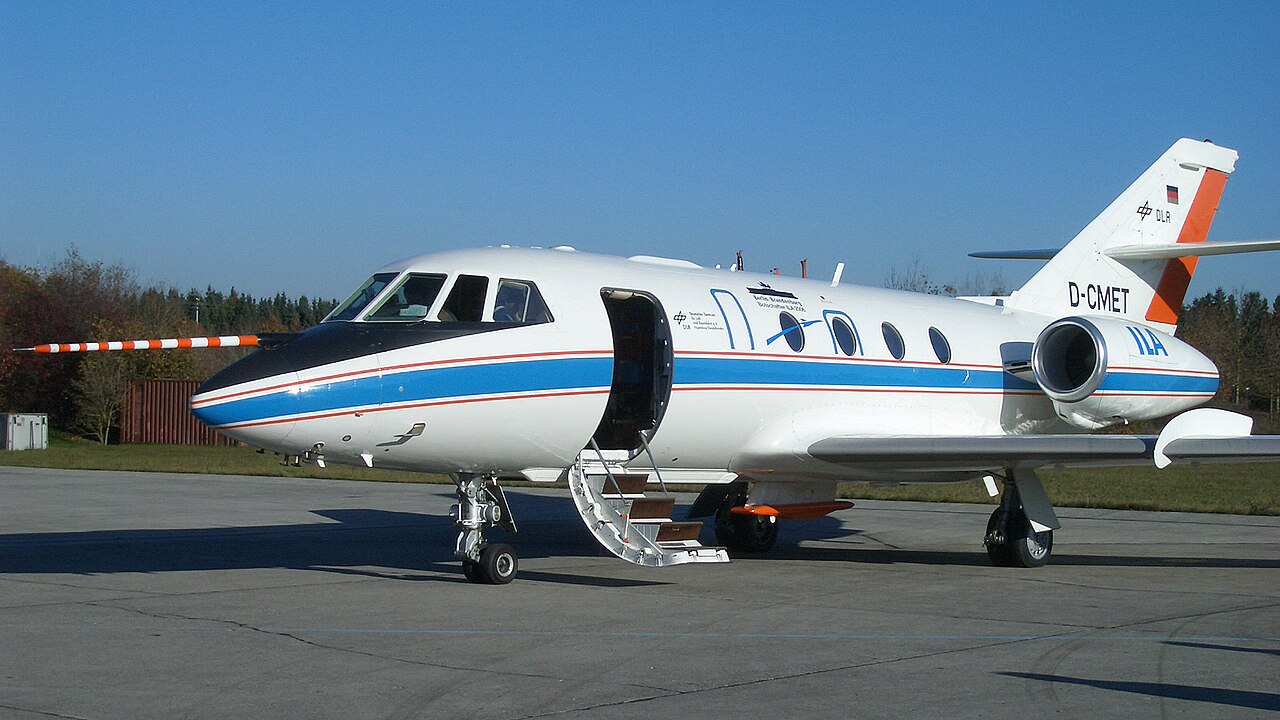
When Mount Etna roars, projecting columns of volcanic ash to stratospheric heights, Mediterranean air traffic enters a state of critical alert. In this hostile scenario, a legendary aircraft takes to the skies to challenge the plume: the Deutsches Zentrum für Luft- und Raumfahrt (DLR) Dassault Falcon 20E. It is not a simple research plane, but a high-performance aerodynamic laboratory serving as the front line of defense for civil flight safety, transforming volcanic risk into precise scientific data.
✈️ Technical Specifications & Performance
Model: Falcon 20E (D-CMET)
Propulsion: 2x General Electric CF700-2D-2 Turbofans
Cruise Speed: Mach 0.74 (800 km/h)
Service Ceiling: 42,000 ft (12,800 m)
Max Range: 3,300 km
History, Birth, and Design Philosophy
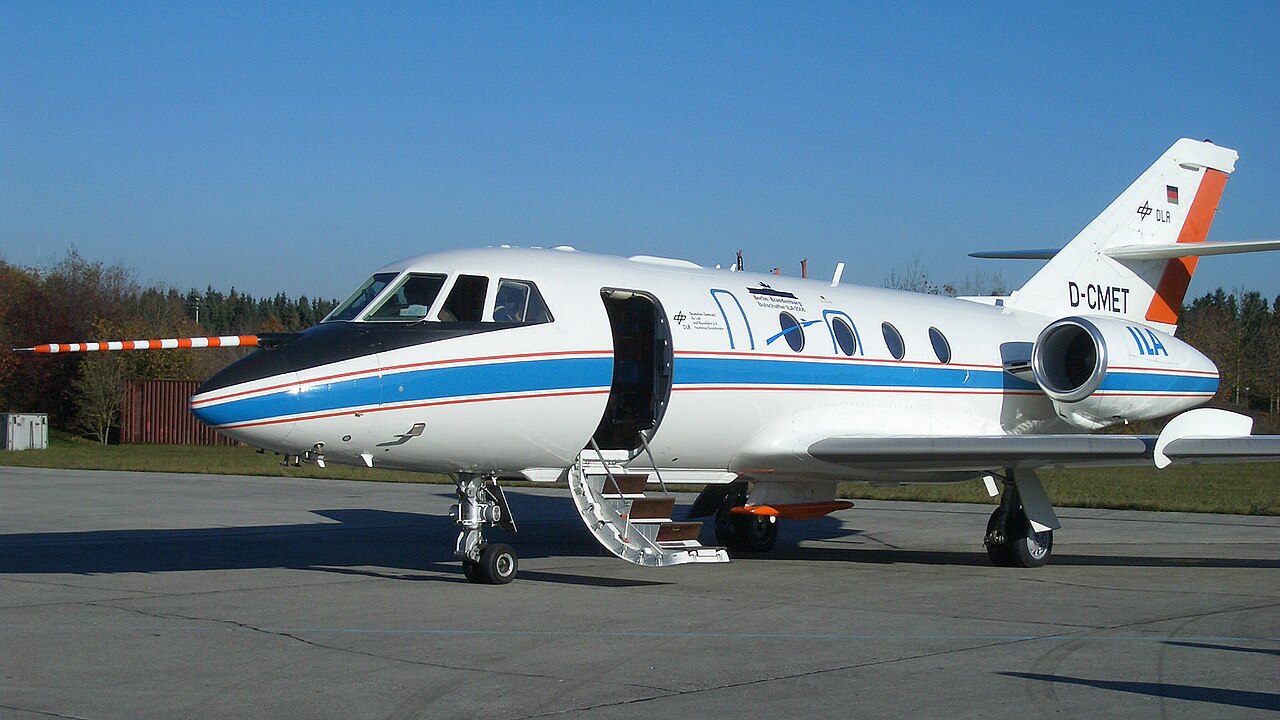
The Dassault Falcon 20, originally known as the Mystère 20, represents a milestone in French aeronautical engineering. Conceived in the 1960s under the aegis of Marcel Dassault, the aircraft was designed with structural robustness derived directly from the military fighters of the era. This genetic heritage is what makes the Falcon 20E (registered D-CMET) the ideal platform for the DLR. While modern commercial jets focus entirely on fuel efficiency, the Falcon 20 offers exceptional stability and tolerance to structural overloads that few other aircraft in its class can boast. Its airframe has been reinforced to house complex atmospheric sampling systems, making it a true 'scalpel' capable of penetrating the edges of volcanic plumes without compromising flight integrity.
Aeronautical Engineering, Engines, and Aerodynamics
The beating heart of the Falcon 20E is represented by its General Electric CF700-2D-2 engines. These powerplants are unique: they are free-flow turbofans with an aft-fan, a configuration that allows rapid response to throttle changes, essential during maneuvers in turbulent air near volcanoes. From an aerodynamic perspective, the aircraft features a 32-degree swept wing, ensuring excellent behavior at high subsonic speeds. For missions over Etna, the D-CMET has been equipped with a suite of external sensors including isokinetic probes for particulate collection and a LIDAR (Light Detection and Ranging) system mounted on the fuselage belly. These instruments allow for real-time mapping of ash density, distinguishing between harmless particles and those capable of vitrifying inside jet engines, causing flameouts.
Life in the Cockpit: Operating Procedures and Pilots
Piloting the Falcon 20E within a volcanic monitoring area requires nerves of steel and millimetric precision. DLR pilots do not follow standard routes; they operate in close coordination with INGV (National Institute of Geophysics and Volcanology) and air traffic authorities to intersect the plume at various altitudes. The procedure involves approaching downwind of the eruptive column, maintaining constant speed to ensure sampling accuracy. In the cockpit, the crew must constantly monitor engine parameters: a sudden increase in exhaust gas temperature (EGT) could indicate the ingestion of siliceous ash. Visibility can drop drastically, and the presence of sulfurous gases makes the work environment extremely demanding. It is a choreographed dance between science and pure airmanship.
Real Missions, Famous Routes, and Operational Challenges
Missions over Etna became a global benchmark after the 2010 Eyjafjallajökull crisis, which paralyzed European skies. During recent Etna paroxysms, the Falcon 20E has operated from Sigonella or Catania-Fontanarossa bases, performing 'sawtooth' (yo-yo) flight profiles between 5,000 and 35,000 feet. This data is instantly transmitted to air traffic control (ATC) centers to decide on the closure or opening of flight corridors. The challenge is not just scientific but logistical: operating in congested airspace while an active volcano expels tons of material requires an operational flexibility that only a highly specialized team and a proven aircraft can offer.
| Technical Feature | Official Data |
|---|---|
| Wingspan | 16.30 m |
| Length | 17.15 m |
| MTOW (Max Take-Off Weight) | 13,000 kg |
| Unit Thrust (CF700) | 20.02 kN |
| Crew | 2 Pilots + 3 Scientists |
| Max Fuel | 4,800 kg |
The legacy of the DLR Falcon 20E is set to endure. Despite the advent of drones and satellites, the ability of a piloted aircraft to sample the atmosphere in situ remains irreplaceable. As Etna continues its relentless activity, the D-CMET remains ready to take off, confirming that aeronautical engineering of the past, if constantly updated, remains the sharpest tool for protecting the future of our skies.